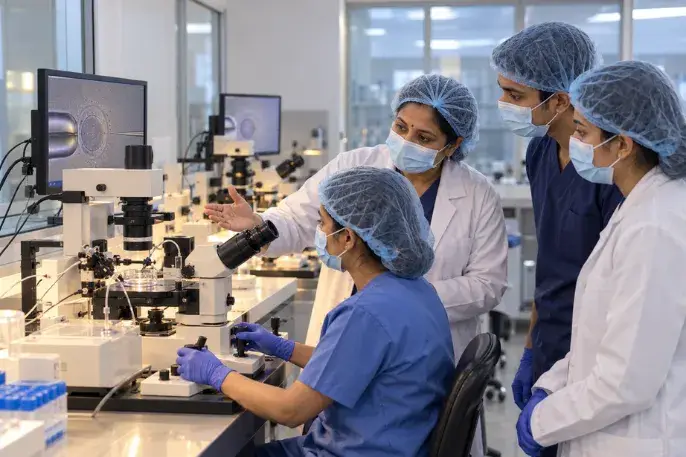
What does a typical day inside an IVF laboratory look like? How do embryologists learn to handle delicate eggs and embryos, operate specialised equipment, and perform procedures that require exceptional precision?
For students planning a career in clinical embryology, classroom learning builds scientific knowledge, while practical experience helps them understand how it is applied during fertility treatments.
This is where lab rotations and internships become valuable. They introduce students to different areas of an IVF laboratory, help develop technical skills, and provide supervised exposure to laboratory procedures and professional practices.
In this blog, we explore how lab rotations, practical training, and internships in a PG Diploma in Clinical Embryology prepare students for careers in Assisted Reproductive Technology (ART).
Clinical embryology involves working with reproductive cells and embryos during fertility treatments. Every laboratory procedure, from sperm preparation to embryo culture, requires careful handling, accurate observation, and strict quality control.
A strong foundation in reproductive biology helps students understand these processes. However, developing practical skills requires experience with laboratory equipment, standard operating procedures, and controlled working environments.
Structured embryologist training helps bridge this gap by introducing students to the practical responsibilities of an embryology laboratory.
Under experienced supervision, students can observe procedures, practise laboratory techniques, and understand how embryologists maintain consistent standards throughout the IVF process.
Lab rotations are structured learning experiences in which students spend time exploring different sections of an assisted reproductive technology laboratory.
Rather than focusing on one procedure, rotations help students understand how various laboratory activities connect throughout fertility treatment.
The exact structure depends on the institution and its training facilities, but practical exposure commonly includes the following areas.
The andrology laboratory focuses on evaluating and preparing sperm samples for fertility treatment.
Students learn about semen analysis, sperm concentration, motility, morphology, and the methods used to prepare samples for assisted reproduction.
They also become familiar with laboratory instruments, sample identification, and techniques such as sperm washing and density gradient centrifugation.
This rotation helps students understand how sperm quality is assessed and why accurate preparation is important before fertilisation procedures.
The embryology laboratory is where eggs are assessed, fertilisation takes place, and embryos are cultured under carefully controlled conditions.
During this rotation, students may observe egg identification, maturity assessment, fertilisation checks, and embryo development.
They learn how embryologists use inverted microscopes, culture media, and incubators to support laboratory procedures.
Students also gain an understanding of embryo grading and the importance of monitoring developmental changes at different stages.
Micromanipulation involves handling microscopic reproductive cells using specialised equipment.
One important technique is Intracytoplasmic Sperm Injection (ICSI), where a single sperm is injected directly into a mature egg.
Students are introduced to micromanipulators, holding pipettes, injection pipettes, and microscopic observation techniques.
Cryopreservation allows sperm, eggs, and embryos to be preserved at extremely low temperatures for future use.
Students learn the scientific principles behind freezing, vitrification, warming, and cryostorage.
This rotation also introduces important aspects of sample labelling, traceability, storage management, and safety protocols
.
Understanding cryopreservation helps students recognise how fertility laboratories preserve reproductive material while maintaining strict standards for identification and handling.
An embryologist internship provides an opportunity to experience the daily working environment of a fertility laboratory under professional supervision.
Unlike classroom demonstrations, internships expose students to laboratory schedules, teamwork, documentation, and the responsibilities involved in handling biological samples.
Interns may observe routine activities, assist with permitted tasks, and learn how embryologists coordinate with fertility specialists, nurses, and other laboratory professionals.
The level of participation depends on the student’s competence, institutional policies, applicable regulations, and supervisor approval.
Internships also help students understand that laboratory work involves more than technical procedures. Communication, time management, ethical responsibility, and attention to detail are equally important.
Practical learning supports the development of several skills that are important for aspiring clinical embryologists.
Students become familiar with microscopes, pipettes, centrifuges, incubators, and other laboratory instruments. They learn how equipment is used, maintained, and monitored to support reliable laboratory work.
Embryologists must identify subtle differences in reproductive cells and embryos. Laboratory exposure helps students develop careful observation skills and understand how findings are recorded and interpreted.
Students learn the importance of contamination prevention, temperature monitoring, sample traceability, accurate documentation, and following standard operating procedures.
An IVF laboratory depends on coordination between different professionals. Internships help students understand workplace communication, confidentiality, and the importance of completing assigned responsibilities accurately.
These skills are developed progressively through guided learning, practice, and feedback rather than through observation alone.
Students may explore opportunities in ART Clinics and IVF Centres
Progression into roles such as Chief Embryologist and Scientific Director in Fertility Treatment Hospitals can be explored further with experience and demonstrated competence.
The programme combines theoretical learning in reproductive biology, infertility, and assisted reproductive technology with practical laboratory education.
Students have access to purpose-built teaching facilities, specialised laboratory equipment, and micromanipulation workstations. Practical sessions are guided by experienced scientific and clinical instructors.
The programme emphasises laboratory skills across embryology, andrology, cryobiology, and Assisted Reproductive Technology. MOMSOON Academy also provides placement assistance to help students explore professional opportunities after training.
Lab rotations and internships play an important role in preparing students for the practical demands of clinical embryology. They provide exposure to different laboratory departments, introduce specialised equipment, and help students understand the responsibilities involved in fertility treatment.
Through supervised learning, students can develop technical abilities, observation skills, and an awareness of laboratory safety and quality standards. For aspiring embryologists, combining academic knowledge with meaningful practical experience builds a stronger foundation for continued professional development and future opportunities in reproductive medicine.